Clearing out the office after ten years in the job has brought back lots of memories. In sorting through my stuff I have unearthed materials and publications from many organisations and projects which no longer exist, their functions having been absorbed by other organisations, or in some cases eliminated altogether.
Subject centres
Having worked at the Subject Centre for Languages, Linguistics and Area Studies, I am unlikely to be dispassionate about the subject centre network. Publications such our Liaison magazine and the English subject centre’s Wordplay are among accidental archive. Some of the subject centres published academic journals which have been taken over by the Higher Education Academy or commercial publishers.
The Learning and Teaching Support Network.
Before the Higher Education Academy there was the Learning Teaching Support Network (LTSN) which consisted of the 24 subject centres based in UK universities and a Generic Centre based in York. The LTSN Generic Centre published a number of useful guides on topics such as employability and assessment. These were rebranded and republished when the HEA was formed.
Fund for the Development of Teaching and Learning (FDTL)
FDTL consisted of five phases, each open to different subjects. Universities were able to bid for subject specific teaching development projects. If I remember rightly phases 1, 2 and 3 predated the formation of the subject centres. A number of languages projects were funded in phase 4, notably in the area of residence abroad.
National Disability Team
I have one of their mouse mats on my desk right now. Produced lots of good resources for helping university teaching staff address the practical and legal aspects of supporting disabled students. I seem to remember that the Special Education Needs and Disability Act (2001) was a key focus for some of this work.
Centres for Excellence in Teaching and Learning (CETLs).
CETLs received a total of £315m to enhance learning and teaching across the sector. The legacy was mixed, as outlined in the HEFCE evaluation:
The report concludes that the legacy of the programme rests largely in individual staff and in those institutions which have embedded CETL developments, rather than in a general enhancement of teaching and learning across the entire higher education sector.
The funding sounds substantial (and indeed it was) but a lot of the funding went into infrastructure, notably new or extensively refurbished buildings.
14-19 Diplomas
Mainly paper work here. The languages and humanities diplomas occupied a lot of our subject centre time in the last year or two of the previous government. The languages, humanities and science diplomas were to be the last to be introduced. The policy was abandoned when the present Coalition Government took power. Although extensive consultations took place and drafts of the curriculum were written, these diplomas never implemented. Possibly a missed opportunity to break the tyranny of A-levels.
The website for our Getting More Out of Feedback is coming along nicely. As part of the Sharing Practice in Assurance and Enhancing Quality (SPEAQ) project, this GMOOF project aims to join up the quality circles of the student, the teacher, and the quality manager. Rather than having separate websites for students, teachers and quality managers on giving and receiving feedback, we recognise that good feedback from teacher to students, students to teachers, teachers to teachers, students to students, teacher to professional body etc. etc. has the same characteristics.
Good feedback has these characteristics, irrespective of who is the provider of feedback and who is the recipient.
The website also contains a brief review of the literature on feedback in higher education.
As well as the xtranormal videos I mentioned in a previous post we have interviews with various members of staff, in preparation. My interview with my LLAS colleague Laurence Georgin is available on youtube and through the site.
Team effort on this one. We made the video for our Getting More out of Feedback Project. The script was adapted from my literature review by Laurence Georgin and Fiona Harvey. Fiona Harvey who works at the Centre for Innovation and Technologies, University of Southampton, produced the drawings. One of our University Digital champions edited the video and did the commentary.
The nanDECK website describes the software as “a software for Windows (any version) written as an aid for game inventors, with the aim of speeding up the process of designing and printing deck of cards (useful during prototyping and playtesting).”
Example of nanDECK code.
Playing cards can of courses be created using a simple programme like word, but nanDECK offers a lot more. Although I’m not over-endowed in terms of artistic skills someone very skilled could make some nice cards.
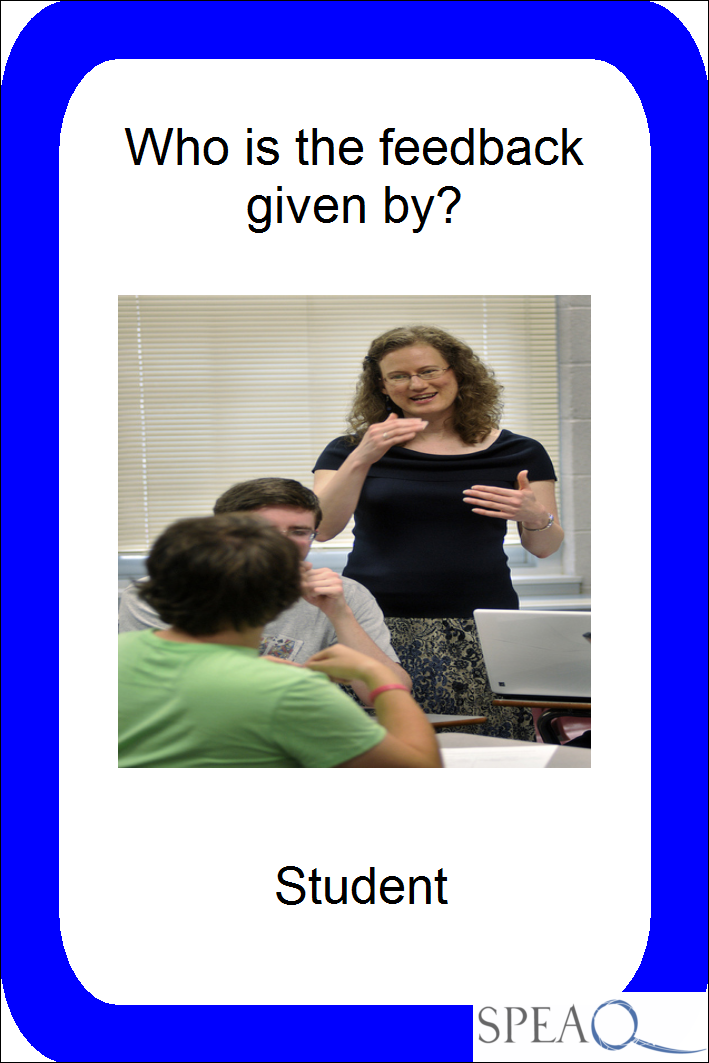
Example of output
I found nanDECK when looking for a way to create cards as a resource for the Getting the Most Out of Feedback project. Originally I wondered if I could use LaTeX, but nanDECK is a specialist piece of software.
Like LaTeX, nanDECK works programmatically. nanDECK involves writing your own code in a text file. I found the online instruction manual very helpful for getting started.
I used it to create a feedback card activity for GMOOF. The code can be found on that website and can be adapted under a Creative Commons license.
Headlines such as Times Higher Education’s “Ucas stats reveal languages decline” have become an annual ritual in recent years. Group R (European Langs, Lit & related) down from 22,486 to 21,248 applicants ( -1,238 -5.5%). Group T (Non-European Langs, Lit and related ) went from 6,678 students in 2012 to 6,241 in 2013 (-437 -6.5%).
I was struck by the vast increase (28.7%) in the number of applicants classified in Z. General, other, combined and unknown. In fact 297,071 students (11.9%) are classified either in a Y category (Combined arts, combined sciences, combined social sciences, sciences combined with social sciences, sciences combined with social sciences or arts, social sciences combined with arts) or in category Z. Given the high proportion of language students who are doing combined/ joint degrees I suspect (but can’t prove) increasing number of linguists are finding their way in categories Y and Z.
For the second year running I have opted to put my SEDA Fellowship report on my website (last year's here). Although I am currently working at the LLAS Centre for Languages, Linguistics and Area Studies at the University of Southampton, I will be joining the Centre for Learning and Teaching at the University of Brighton in September. I was offered the Brighton job back in May so I am very much in a transition frame of mind at present.
Career development
After ten years at the LLAS Centre (counting the centre in its LTSN/ HEA subject centre forms) I felt it was now time to move on and undertook a UK-wide job search. The end result was an offer from the Centre of Learning and Teaching at the University of Brighton. Last week I visited Brighton for the university’s internal teaching and learning conference and heard about a lot of the interesting things about some of the interesting things which are going on there. It was also nice to spend time getting to know some of my new colleagues as well.
Statistics for Humanities
Tweet referring to the Statistics for Humanities book.
This past year has been mostly project based. My Statistics for Humanities student ‘text-book’ is available in draft form and I am awaiting comments from the British Academy nominated reviewers. The British Academy agreed that I could put a draft online for a crowd sourced review. This has led to receiving many helpful comments, and one academic in particular has provided some very extensive feedback. I have long been dissatisfied with introductory statistics textbooks. I hope that mine will reach out to students (and academics) who struggled in the past. The examples in the book come from the humanities and I have attempted to write a book which uses a verbal reasoning-based approach which should resonate better with humanities students than some other texts.
EU Quality Assurance project
University of Aveiro, Portugal. Venue for our third project meeting in December 2012.
We are coming to the end of the second year of this 2-year EU-funded project, Sharing Practice in Assuring and Enhancing Quality (SPEAQ) which follows on from LANQUA (the Language Network for Quality Assurance). I didn’t work on LANQUA and hadn’t worked on an EU-project before. I was quite apprehensive about being involved in the project as I had seen colleagues undergoing the stresses of running a project which involves administrative complications (e.g. currency conversions and daily rates) as well as working alongside colleagues in other countries who work in very difference pedagogic, policy and quality environments. Fortunately our assistant director (and my line manager) Alison Dickens is an experienced director of EU–projects and our senior administrator Sue Nash has worked on them before, so, fortunately for me, I have been able to concentrate mostly on content issues.
Delegates at SPEAQ workshop, at European Quality Assurance Forum, Tallinn
In the first year of the project we developed a workshop in which staff, students and quality managers can participate together. I played a big role in this aspect of the project producing a dialogue sheet and writing facilitator instructions. Along with our Danish colleague Ole Helmersen from Copenhagen Business School I attended the EQAF Forum in Tallinn, Estonia where we tried out the workshop on a large group of quality professionals from a range of European countries.
As well as running the workshop the EQAF conference was a great staff development opportunity for me. As a QE person rather than QA person it was interesting the meet people who operate in very different QA systems. The UK seems to be fairly in the middle between those countries in which QA is very highly centralised and regulated through to countries where QA is virtually non-existent—at least in the way that I understand it. If there is one thing that all countries seem to have in common it is that QA appears very different from teaching. As one person I met pointed out, a poor teacher is not a quality issue as far as most university structures are concerned. Even at the Senior Manager level there is often a separation of roles between the person in which of QA and the person who in charge of teaching and the curriculum.
For the second part of the project each partner does their own small-scale project which meets a particular institutional need. At Southampton we decided to do a project on feedback, called "Getting the Most Out of Feedback" (GMOOF). The core principle of GMOOF is that everybody, whether a member of teaching staff, a student or a quality manager, is both a provided and recipient of feedback. The principles of good feedback: Relevant, Timely, Meaningful and with Suggestions for improvement (See Race online), apply to all feedback, not just feedback from teacher to student but also student to teacher, student to student, teacher to teacher etc., teacher to quality manager, teacher to professional body etc. etc. GMOOF is a website which focuses on giving good feedback and making the most of feedback from others rather than focusing on different job roles. (The website is under development at present). A workshop based on the project is being developed and will be piloted in Southampton in September – I’ll be in Brighton by then so will not be leading it(!) Additional material for the website includes a card sort (built using the free software nanDECK), a series of feedback videos with reflective questions (built in xtranormal and put up on youtube), videos of interviews about feedback with the project team and other colleagues at Southampton, and online quizzes for staff and students. There is also a section specific on how we at Southampton work to enhance the quality of teaching across the university.
Teaching
My teaching this year has focused in two major areas. I have been contributing to the interdisciplinary Curriculum Innovation module “Sustainability in the Local and Global Environment"). 2012-13 was the first time this module has run and I benefited greatly from working with National Teaching Fellow Simon Kemp. It has been some years since I taught undergraduates and the modules made extensive use of technology (including Twitter, Panopto, Blackboard) and had a variety of assessments including a presentation, conference paper and group film project.
My other teaching responsibility has involved teaching research skills to (mostly Humanities) doctoral students. I have run numerous sessions on everything from putting the thesis together, preparing for the viva, ethnographic methods, critical thinking and applying for funding. Most of my materials are available in the HumBox under a Creative Commons license. Students produce critical reflections on the sessions, which also provide me with feedback.
I also presented at the LLAS e-learning symposium about my online open access language teaching research website YazikOpen. I have also been preparing materials for the LLAS annual Heads of Department workshop, which is entitled “Thriving for the Public Good”
Future
At Brighton I am expecting to be involved in a variety of academic development activities including working with teaching staff to apply for the HEA Fellowships, blended learning and undertaking research. I will also being going to Plymouth in November to undertake PASS (Peer Assisted Study Session) Supervisor Training.
I joined my new colleagues at the University of Brighton last Friday for their internal teaching and learning conference. Lots of new ideas including think about the role of silence in teaching (I'll try to write a bit more about this). Had lots of great conservations as well. I will be joining the Centre of Teaching and Learning on 1st September.
A while back I wrote a short post about WEFT QDA, a free research package for qualitative data analysis. I was postive about it because, alough quite basic, was very user friendly. As I am undertaking a short evaluation project at present I thought I would revisit it. I spotted from the website that it has not been updated since 2006 and was optimised for Windows XP. When I wrote that ‘review’ I was running Windows XP on my work computer. I haven’t done much qualitative stuff recently so until today I had not tried it since I upgraded to Windows 7 at work. I could not get it to work. The author is no longer working on it, and I (for one) do not have the expertise to do anything with the source code. This is one of the hazards of free software of course!
My research led me to try out AQUAD 7 (Analysis of Qualitative Data). On the up side this is a very powerful piece of software, which can be used in the analysis of pictures and sound files as well as text and enables linkages, keyword hierarchies and some basic statistical functions (e.g. Chi-square). If that wasn’t enough there even seems to be some compatibility with the free statistics software “R”. On the downside this is definitely not a piece of software you can install and get working right away. The 200 page manual is compulsory reading to get started though the authors have provided some demonstration files which are useful. I’m still trying to get to grasp with the different file types which can be used to create lists of codes and metacodes. I haven’t found it particularly intuitive, but it has so much functionality I’m going to stick with it.
In conclusion this is definitely a piece of software worth exploring if you are looking for free qualitative data analysis software. The most striking thing about the manual is the way it explains the software by reference to theoretical frameworks from the qualitative research literature, something I can’t say I’ve seen in a software manual before. The software was originally developed in German, and there are odd places where translation has not taken place. For the most part the German only appears when you do something wrong!


 econd year running I have opted to put my SEDA Fellowship report on my website (last year's


