Fighting the end of level monster, aka the PhD viva

I don't play computer games nowadays, I but assume that the end of level monster lives on in some form. In a computer game the end of level 'monster' (could be a spider or some other 'baddie') shows up after you have completed all other tasks on that level. Progress to the next level depends on being able to defeat the monster. PhD vivas are often presented in these sorts of terms. The hero has done everything s/he needs to do (her/his thesis) but now needs to do to defeat the ultimate adversary (aka external examiner).  The opposite 'danger' is that of complacency; that the viva is a mere formality, and all the candidate has to do is turn up and have a chat.

Today I have been making final preparations to the Postgraduate Research Training Programme session entitled ‘Your Viva: Q & A’, which takes place tomorrow morning.

I was tempted to invite recent graduates in to talk about their experiences of the viva, but had second thoughts. Firstly too many of those narratives are along the lines of “I was very nervous, but it was all OK in the end”. Nothing wrong with that of course (it pretty much sums up my experience) which brings me to the second point—that for reasons of balance it is essential to bring in someone who had problems, which I don’t really fancy doing. Thirdly with over 400 postgraduates in the Faculty I assume that most of them will be in touch with recent candidates who can share experiences.

Instead I will be helping the students to be able to talk about their thesis, in a ways which would in viva situtation.

1. Explain in the space below what your thesis is about: This space is small, but it is useful, not only for the viva ,but also for job interviews/application to be able to summarise the thesis is a few sentences.

What is your thesis about


Other questions include:

2. How would you describe your approach to the topic in terms of methodology/ theoretical approach/ philosophical approach?

3. I think the strengths of the thesis are…

4. My thesis makes an original contribution to knowledge by…

5. The questions I most look forward to answering about my thesis are…

6. The questions I fear most are…

7. I am excited about my viva because…

8. I am worried about my viva because…

9. I think I can impress the examiners by…

10. Things I need to find out before my viva are…

I have put together a pack which includes:

Handouts for the PhD viva session
  • Questions and reflections (I’ve printed these off in Pink), including the above questions and some questions on “Darren’s” situation (see below).
  • Preparing for your viva: This University of Leicester document (available under a Creative Commons Licence) slightly modified for the University of Southampton. (Printed on buff paper).
  • When things go wrong. Messy viva situations are something of a taboo I believe, but a non-Southampton student, “Darren” whose experience was not good has shared some viva reflections with me. (He has said I can use them with my students as long as I don’t reveal his identity). (Printed on white.) I think these reflections would be a good OER, but I don’t have that level of permission at this stage). We will be discussing these reflections in the session.
  • Some internal documents relating to University of Southampton procedures.
  • A University of Southampton PhD viva checklist. (Most of this relates to knowing when and where the viva will be held).
  • A (blank) copy of the Doctoral Examiners’ Joint report form (for the University of Southampton).

I’ve not run this session before but I’m optimistic it will go well…

  • Twitter
  • del.icio.us
  • Digg
  • Facebook
  • Technorati
  • Reddit
  • Yahoo Buzz
  • StumbleUpon

SPEAQ workshop at European Quality Assurance Forum, Tallinn

Around 25 delegates at the European Quality Assurance Forum in Tallinn came to the workshop Ole Helmersen and I facilitated as part of our role in the Sharing Practice in Enhancing and Assuring Quality (SPEAQ) project team. The target audience of the conference meant that a majority of participants were in quality management roles. In contrast, the workshops I co-facilitated in Southampton and Edinburgh had mainly academic and student participants.

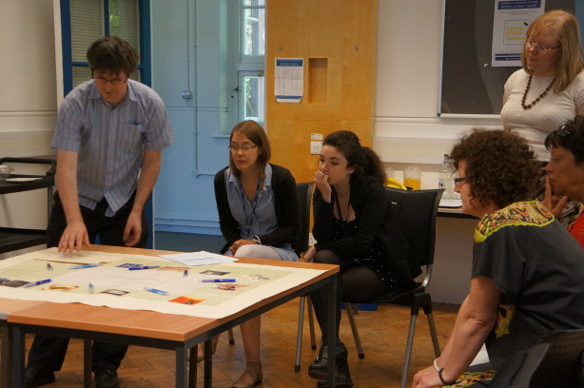
Delegates at SPEAQ workshop, Tallinn

The project as a whole seeks to bring together academics students and quality managers in the Quality Assurance process. One of the ways in which we do this is through a dialogue sheet whereby people think of questions they would ask to assess the quality of everyday objects or services ranging from spanners to sofas to hospitals (my colleague Laurence Georgin has written more a detailed post about the workshop). They then go through the questions to discuss which questions they could also ask about higher education institutions or course programmes.

Delegates at another table

In terms of feedback from participants three emergent themes which struck me, which have been less evident in previous workshops. These differences are a consequence of both the fact that most of the participants were quality managers and the different academic systems in which they work.

  1. Participants brought up the question of internal processes, which are, of course, a key part of their job role.  However as end-users of a product (whether as a patient in a hospital, a user of a spanner or a student on a higher education course), internal quality processes are not considered or addressed unless a problem emerges which gives course for an end user (or his/her representatives) to question internal quality processes.
  2. The durability of a product: a sofa may seem to be good quality at the point of purchase, but what happens if it falls apart a year later? Is an academic course durable? What if fails after purchase, (e.g. during the course or after graduation), despite seemingperfectly adequate for a length of time?
  3. Poor teaching: Is poor teaching quality a quality issue? On one hand the obvious answer is ‘yes’, but responsibilities for bringing poor performers up to standard usually lies with senior academics (Heads of Departments, Deans etc.,), not quality assurance managers. These questions also arise if ‘quality issues’ are a consequence of individual teacher illness or disability. In a multi-national setting cultural, historical and organisational structures can lead to different processes and outcomes.

The workshop powerpoint slide and files will be available in the few weeks.

  • Twitter
  • del.icio.us
  • Digg
  • Facebook
  • Technorati
  • Reddit
  • Yahoo Buzz
  • StumbleUpon

Lessons from the USA: Update from Tallinn


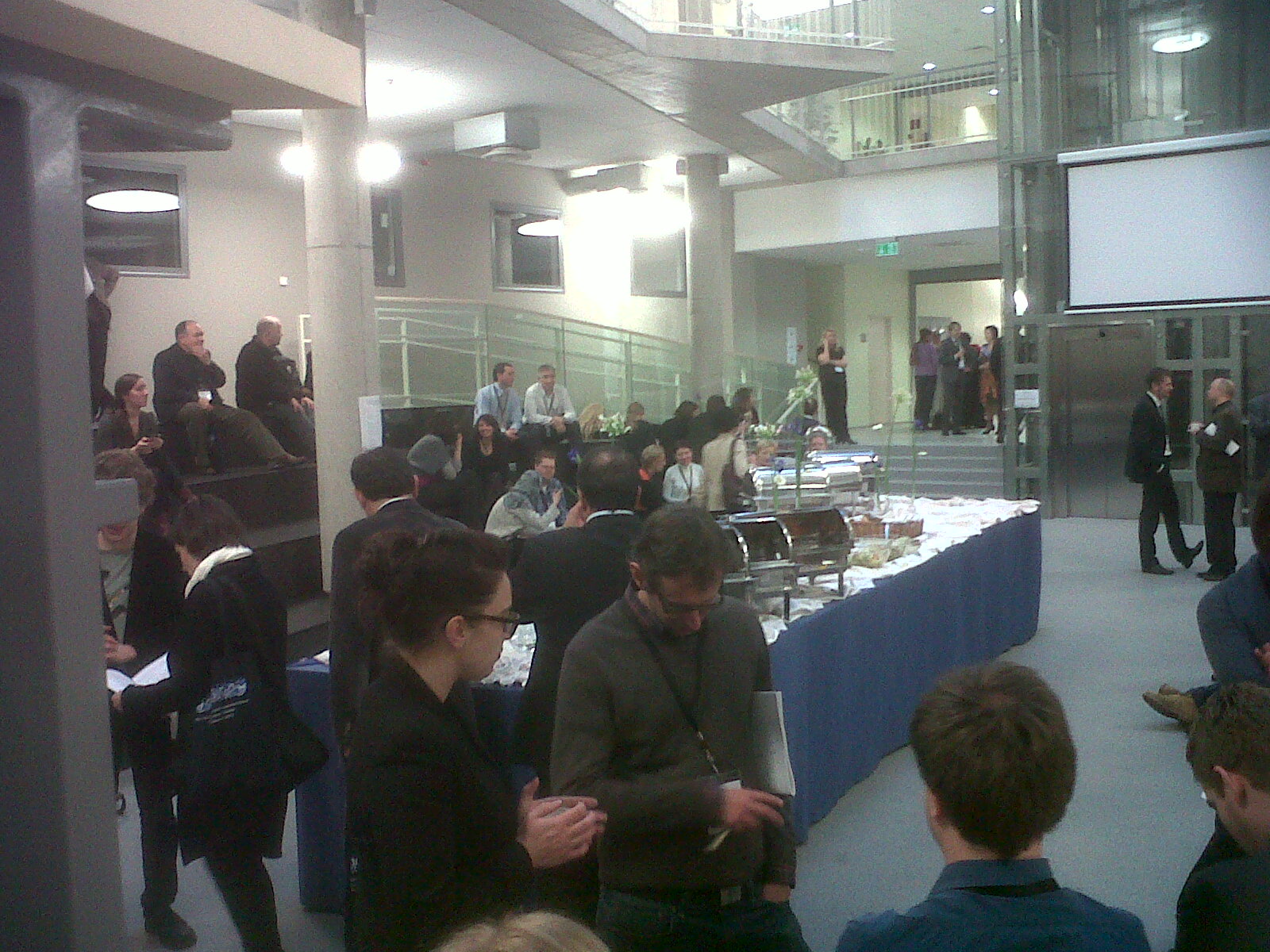
Lunch at EQAF conference, Tallinn
Lunch at EQAF conference, Tallinn University

Sylvia Manning from the US Higher Learning Commission was this morning's keynote speaker. She began with an historical overview of accreditation in the USA. Historically government has played a lesser role in Higher Education than in Europe. It was not until after WW2 when the federal government began to supply funding for war veterans that government interest in accreditation really began.

One of the important tends in US higher education has been the rise of 'for-profit' universities. In order to receive federal funds universities has to be accredited in all the states in which they operate (accreditation is regional in the USA). This was not a problem for the larger 'for-profits' e.g. University of Phoenix, but an unexpected consequence was that smaller colleges, especially those engaged in distance learning were left in limbo. Professor Manning gave the example of a student in the armed forces taking a distance learning course accreditation in the state where the army base is located. However, if the student is then relocated to another base in a state in which their college is not accredited they are no longer able to access federal student loans.

Professor Manning asked her audience to draw their own 'lessons' from the USA situation. The keenness of the current UK government for expanding accreditation  in the private sector and the emergence of 'for-profits' present many challenges for quality assurance in the UK.

  • Twitter
  • del.icio.us
  • Digg
  • Facebook
  • Technorati
  • Reddit
  • Yahoo Buzz
  • StumbleUpon

Live from Tallinn: Does QA lead to enhancement?

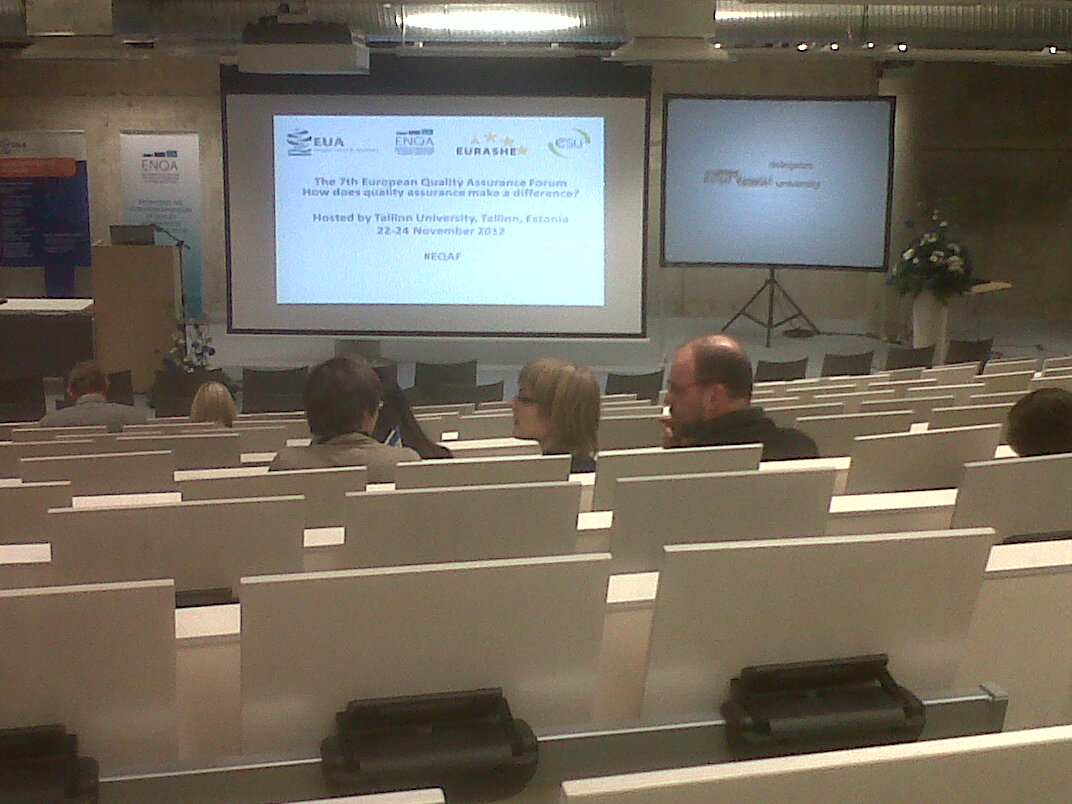
Awaiting Jethro Newton's keynote

I promised that I would blog and tweet from the European Quality Assurance Forum.

This evening we were treated to a keynote address from Jethro Newton (University of Chester) on the question, 'Does quality assurance lead to enhancement?' One of his central points is there has been very little actual research into this question.

Professor Newton also used the term 'Quality Revolution' to describe the changes in QA since the early 1990s. A member of the audience challenged him on this- it does seem to suggest something more radical than actually happened.

  • Twitter
  • del.icio.us
  • Digg
  • Facebook
  • Technorati
  • Reddit
  • Yahoo Buzz
  • StumbleUpon

Preparing for the European Quality Assurance Forum (EQAF), Tallinn

I will be heading off to the European Quality Assurance Forum in Tallinn, Estonia later this week.  I will be running the interactive workshop we have developed for our EU-funded Sharing Practice in Enhancing and Assuring Quality. I will be running the workshop with my Danish colleague Ole Helmersen of Copenhagen Business School. We have already run the workshop in Southampton and in Edinburgh, and other partners have run the workshop in their own institutions.

SPEAQ workshop, Southampton
SPEAQ workshop with colleagues in Southampton.

At the end of the project next year the materials will be made available online in the the languages of the project partners.

All being well I intend to tweet and blog from the conference.

  • Twitter
  • del.icio.us
  • Digg
  • Facebook
  • Technorati
  • Reddit
  • Yahoo Buzz
  • StumbleUpon

Using pgfplot LaTeX package for basic dotplots.

Amended 11 March 2016

I wanted to produce a basic dotplot using the LaTeX pgfplot package. I looked for guidance in the extensive manual but didn't find what I wanted (that is not to say it's not there). I managed to find a workaround, which I have shared here. The results are not perfect, but will do for now.

This is the table containing my data:

Subject Marks out of ten Mean Average Median average
French 2, 4, 5, 7, 7 5 5
Religious Studies 0, 5, 10, 7, 3 5 5
History 5, 5, 4, 6, 5 5 5

I used the scatterplot as the basis for the dotplot and worked out this code.

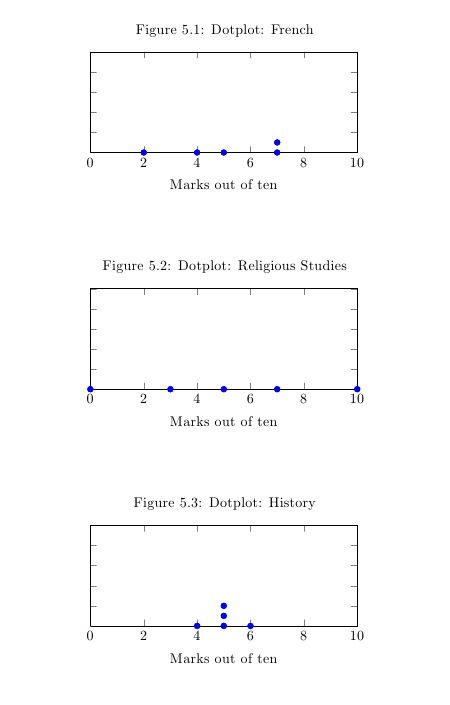
I did three of these. Here are the results. Not too bad.


\documentclass{article}
\usepackage{pgfplots}
\pgfplotsset{compat=1.9}
\begin{document}
\begin{figure}
\centering
\caption{Dotplot: French}
\begin{tikzpicture}
\begin{axis}[
xlabel={Marks out of ten},
ylabel={},%no label for the y axis
yticklabels={}, %no numbers displayed on the y
ymin=0,
ymax=10,
xline,
xmin=0, %sets the minimum of the x axis
xmax=10, %sets the max of the x axis.
%As the test was out of ten I have set max to 10.
]
\addplot[scatter,only marks,
scatter src=explicit symbolic]
coordinates
{
(2,0) %the first number is the marks out of ten (the x axis).
% Use 0 for the y axis until the second occurrence.
(4,0)
(5,0)
(7,0)
(7,1) %the second number here is 1 because we have already used 7,0.
%This is because 2 people got 7 out of 10.
};
\end{axis}
\end{tikzpicture}
\end{figure}
\end{document}

Dotplot output from pgfplot package


  • Twitter
  • del.icio.us
  • Digg
  • Facebook
  • Technorati
  • Reddit
  • Yahoo Buzz
  • StumbleUpon

LLAS Centre for Languages, Linguistics and Area Studies, 8th annual e-learning symposium 24/25th January 2013

I will be presenting about my open access language teaching research directory YazikOpen.

The LLAS Centre for Languages, Linguistics and Area Studies will hold its 8th annual e-learning symposium on 24/25th January 2013. The aim of the symposium is to seek to bridge the gap between the ‘techie’ and the teacher, giving educators ideas to help them integrate e-learning into their practice but also to inspire them to see where the online future could lead. The symposium is always well-attended by practitioners from a wide range of disciplines and institutions.

Main themes for the 2013 symposium are:

  • Innovative tools for teaching
  • Digital literacy for staff and students
  • QR codes in teaching
  • iTunesU
  • Augmented reality
  • Innovative grammar teaching
  • MOOCS and language study

Keynote speakers:

Professor Mike Neary, Dean of Teaching and Learning at the University of Lincoln
Professor Allison Littlejohn, Chair of Learning Technology, Glasgow Caledonian University, Director of the Caledonian Academy
Professor Grainne Conole, Professor of Learning Innovation, University of Leicester
Nik Peachey, Associate Trainer Bell Educational Services

REGISTER NOW TO GET THE EARLY BIRD RATE: £150 for both days (standard rate £200)

This applies to registrations and payments made by 23.59hrs on 20 December 2012.


To register or get more information on the event, go to www.llas.ac.uk/events/6636


We look forward to seeing you there!

LLAS e-learning symposium

  • Twitter
  • del.icio.us
  • Digg
  • Facebook
  • Technorati
  • Reddit
  • Yahoo Buzz
  • StumbleUpon

Applying for Fellowship of the Higher Education Academy (Professional Recognition Route)

Added 17/12/2013

See also: Ten useful things to remember when applying for HEA Fellowship­ (D1 and D2, Professional Recognition Route) 

This post is only about becoming a Fellow by Application. The alternative route to Fellowship is through accredited provision (e.g. a Postgraduate Certificate course taken by early career lecturers). I do not discuss the Senior and Principal Fellowships here.

Disclaimer: I don’t work for the Higher Education Academy (HEA) or assess Fellowship applications. These are all my own thoughts/ opinions.

From time to time I have discussions with colleagues asking for my advice about applying for Fellowship of the Higher Education. In some cases they have been advised that it would be a good to get the Fellowship. The application route is aimed mainly at experienced teachers in higher education who have not yet got a fellowship through the professional recognition routes or through membership of the Institute of Learning and Teaching (ILT) prior to about 2005.

Why apply for Fellowship of the Higher Education Academy (FHEA)?

There are many reasons why you might apply for the Fellowship. Some universities are aiming to ensure that all academic staff either have the FHEA or are on their way to getting it. After all students do not want to be paying up to £9,000 to be taught by people with have never studied teaching in some form.  An increasing number of jobs are listing FHEA as an ‘essential’ job requirement, as opposed to a ‘desirable’ attribute as was often the case in the past. Those without FHEA may find themselves being unsuccessful in applying for jobs and promotions they are otherwise well qualified for.  Even if your university has no requirements for FHEA there is the possibility that this could change or that you may wish to apply for a job in a university which does have the requirement. With many academics facing redundancy and re-deployment being FHEA-less at a time of great uncertainty could be a potential barrier to taking the next step.

Most of those who talk to me about FHEA are experienced academics or educational developers who have ‘never got around to it’. (Newer colleagues tend to get theirs through the accredited provision route). They find the application form somewhat daunting though it is only around 3000 words in total. Unless individuals are strongly encouraged/ forced by their managers, more pressing professional and personal activities take over and the FHEA application is always at the bottom of the ‘to do’ list.

The application process

The HEA website helpfully lays out the application process. The centrepiece of your application is the Account of Professional Practice (APP). This is laid out in five sections under which you need to write your evidence. It can seem daunting at first, but all you are really doing is writing about your own practice. Writing about the things you do shouldn’t really be that difficult. The sub-questions in each section are actually there to help and give ideas.

  1. Evidencing A1: Design and plan learning activities and/or programmes of study
  2. Evidencing A2: Teach and/or support learning
  3. Evidencing A3: Assess and give feedback to learners
  4. Evidencing A4: Develop effective learning environments and approaches to student support and guidance
  5. Evidencing A5: Engage in continuing professional development in subjects/disciplines and their pedagogy, incorporating research, scholarship and the evaluation of professional practices

Things to remember.

Essentially the guidance notes and sub-questions are telling you exactly what to write, removing some the ambiguity in the previous form (I got my fellowship in 2008).

‘Learners’ are not just 18-22 year old undergraduates, but could be academic colleagues, evening class students, community learners.  I was not involved in teaching undergraduates when I applied and my ‘learners’ were the academics I ran and organised workshops for.

Similarly assessment and feedback are not just assessed summative assessments, but also formative assessment and feedback. This might include feedback to colleagues, evaluation work or providing academic support to students outside the formal boundaries of their course.

Most importantly the FHEA is a benchmark for all those who teach or support teaching in higher education. In short this is not about being the best, most popular or innovative teacher, but about showing that you are competent to teach in higher education. Awards such as the National Teaching Fellowship Scheme exist to recognise and reward excellent learning and teaching. The FHEA is about competence, not greatness .

Finally

Crucially, this is about you and the things you do and think . Writing about yourself, your experience and your practice can only be beneficial for your development as a teacher in higher education.  Don’t see it as a burden. See the Fellowship application as a great opportunity.

  • Twitter
  • del.icio.us
  • Digg
  • Facebook
  • Technorati
  • Reddit
  • Yahoo Buzz
  • StumbleUpon