Converting tables from Excel 2010 to LaTeX using excel2latex add-in

Orginal Excel 2010 table

Building all but the simplest tables in LaTeX is not a particularly intuitive process. I’ve just been trying out the Excel2Latex add-in for converting tables from Excel (2010) into LaTeX. I eventually got it to work, but it look a lot of on-line detective work to work it all out. It appears that it was easier to use in Excel 2003.

  1. First of all you need to download the add in file  The file has the extension .xla
  2. It will tell you to open the file in excel. When I tried to open the file in Excel nothing happened, but the file got saved under username/temp rather than in username/downloads. (as I was opening it up online).
  3. In early versions of excel this might have been enough and the Excel2Latex add-in would appear under the tools menu. This was not the case in Excel 2010.
  4. I then opened Excel and clocked on “File”, then “Options”.
  5. I then selected Add-ins from the left hand side.
  6. A list of available Add-ins came up, but Excel2Latex did not appear.
  7. At the bottom of the dialogue box you should find the word ‘Manage’. Select Add-ins from the drop down menu and click ‘Go’
  8. A list of available add-ins will appear. If Excel2Latex is there select it, but in my case it was not there. If this is the case click ‘Browse’ and find the file excel2Latex.xla. Select it and it should be added to your list of add-ins.
  9. Now close Excel down.
  10. When excel is re-opened a new heading will appear at the top of the Excel window labelled ‘add-ins’ . Click on this menu item and you should see two new buttons. “Convert table to LaTeX” and “Convert all stored tables to LaTeX”.
  11. Open up an excel file (if you have not already done so) and Click on “add-ins”, then “Convert table to LaTeX”. New buttons
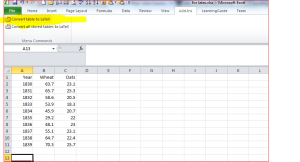
  12. Excel will then generate the LaTeX code for your table.LaTeX Code generated  in Excel
  13. Export or copy+paste into your usual .tex/ LaTeX editor
    Code pasted into my LaTeX editor
    Code pasted into my LaTeX editor

  14. The final result in my .pdf file! Looks nice I think.

    PDF screenshot
    PDF screenshot

Notes

Excel2latex can cope with formats such as italic and bold,but not colour at present.

  • Twitter
  • del.icio.us
  • Digg
  • Facebook
  • Technorati
  • Reddit
  • Yahoo Buzz
  • StumbleUpon

No open learning without open access: a portal for open access research into teaching modern languages.

LLAS logo

My abstract for the LLAS 8thannual elearning symposium next January has been accepted, so all begin well I will be speaking about YazikOpen and broader issues surrounding open access there. The symposium will take place in Southampton on 24-25 January 2013.

Abstract

The effectiveness of Open Educational Resources (OER) and Mass Open Online Courses (MOOCs) can be seriously undermined by lack of open access to original academic research. Copyright restrictions and subscription fees mean that most research is completely unavailable to those who are not staff or students at a university, or who work in institutions or countries where financial resources are very limited. At best, those with limited access to original research are forced to rely on the summaries and interpretations of others.

This presentation showcases YazikOpen.org.uk a portal for open access research into the teaching and learning of modern foreign languages. The portal catalogues language teaching research published in open access journals or on open websites. This research is available to anybody, anywhere in the world with access to the internet without viewing or subscription fees.open access logo

Those teaching on courses relating to language teaching (e.g. TEFL, Applied Linguistics, Teaching Training etc.), whether face-to-face or online, can search YazikOpen to identify course readings which will be available to all students, irrespective of institution, geographical location or access to financial resources. Open access also means that original research is accessible to practitioners such as schoolteachers, Teachers of English as a Second/ Foreign Language, teachers at language clubs and teachers of languages in the community. Bringing down access barriers also means that practitioners and other interested parties can engage in debates and publish their own research with fewer disadvantages.

The presentation will also explore the wider discussions currently taking place about open access from the ethical as well as the financial and organisational perspectives. Open access to research is also crucial in ensuring that MOOCs are genuinely open and inclusive and do not perpetrate the current privileges of students and staff in well-resourced institutions.

  • Twitter
  • del.icio.us
  • Digg
  • Facebook
  • Technorati
  • Reddit
  • Yahoo Buzz
  • StumbleUpon

Five (possible) barriers to quantitative methods in the social sciences

The news that the Nuffield foundation, the ESRC and HEFCE are to invest £15.5m in centres to develop quantitative skills in the social sciences is very welcome. Nuffield foundation director Sharon Witherspoon’s article, why the social sciences need a skills step-change in the Guardian was published the same day that Society Counts was launched by the British Academy.

My university degrees (BA, MSc, PhD) are all in geography, a discipline which underwent a ‘quantitative revolution’ in the 1960s. At the risk of over simplifying the history of geography the quantitative revolution can trace its routes to Fred K Schaefer’s posthumously published 1953 article “Exceptionalism in Geography: A Methodological Examination in the Annals of the Association of American Geographers”.  Schaefer’s sudden death prior to the article’s publication meant that he was unable to respond to or defend criticism of his ‘scientific approach’ from the likes of Richard Hartshorne, yet there was no shortage of geographers willing and able to build on Schaeffer’s idea. According to the more simplistic narratives of the history of geography, quantitative approaches were gradually edged out during the 1970s as more behaviourist and qualitative approaches took over.  By the time I arrived at university as an undergraduate in 1994 statistics was very much, in Witherspoon’s words, a ‘bolt-on’ module. (Please don’t cite this blog post as an authoritative reference for the history of geography.)

I’ll leave the relative merits of different approaches   to one side, but I’ll share some thoughts about why quantitative approaches are frequently rejected.

  1. There is an adage that if you can add, subtract, multiply and divide you can do statistics. If we are talking about the mechanics of undertaking statistical tests then there is a degree of truth in this, but how many beginners’ statistics texts adequately explain the normal distribution, z scores or standard deviations? This stock diagram always appears in some form, but few attempts are made to really demystify it. Who came up with this? What is a standard deviation? Why are 68% of values within one standard deviation of the mean? The beginner is more or less asked to accept this as an article of faith.
  2. Similarly critical values. You have to look up your answer on a table of critical values somewhere in the back of the book. Again the beginner is not troubled with any sort of explanation about where these critical values really come from. Why different scores for t, q, u, chi etc.
  3. The internet is the enemy of the beginner. This is slightly unfair as there is some good stuff out there, but most statistics resources reinforce the above.
  4. Statistics as a ‘bolt-on’ leads encourages surface learning. Statistics is a hurdle that has to be cleared. Technique is emphasised above understanding. Even the best teachers of quantitative social scientists don’t have time or scope to get to grips with true understanding.
  5. The pressure to learn statistical analysis software creates an additional barrier in time and learning.

Rebuttals and thoughts welcome.

  • Twitter
  • del.icio.us
  • Digg
  • Facebook
  • Technorati
  • Reddit
  • Yahoo Buzz
  • StumbleUpon

British Academy publishes position statement on quantitative skills

From the British Academy 'Society Counts' webpage.

The British Academy has launched a Position Statement on the issue of a quantitative skills deficit in the humanities and social sciences. Well-rounded graduates equipped with core quantitative skills are vital if the UK is to retain its status as a world leader in research and higher education, rebuild its economy and create a modern participating citizenry. Quantitative methods facilitate ‘blue skies’ research, and without them, effective, evidence-based policy-making would be unthinkable. Yet, the UK currently displays weak quantitative ability within its humanities and social sciences.

The online book for Statistics for Humanities I am working on is funded under the Languages and Quantitative Skills programme.

  • Twitter
  • del.icio.us
  • Digg
  • Facebook
  • Technorati
  • Reddit
  • Yahoo Buzz
  • StumbleUpon

Update on the "Statistics for humanities" website and the failings of the Internet

Firstly…

For the past few months I have been working on a British Academy funded online book to introduce humanities students to statistics. The website is under development and is not public at present. If any readers are interested in providing feedback, please get in touch (j.canning[at]soton.ac.uk) and I can give you an access password in the next few weeks.

Why is this website/ book/ resource is needed?

There are thousands of introductory statistics texts on the market, and I’ve only looked at a small number of them.  In my view a majority of them go too far too fast. For some disciplines this may be appropriate, but introducing the normal distribution in Chapter 1 is frightening to students who have not studied mathematics since the age of 16, and many humanities students are in this situation.  Just to give an example I have the Second edition of Statistics in Geography by David Ebdon on my desk.*  I bought it when I was a geography undergraduate in the mid-1990s, by which time the text was almost 20 years old. I actually think it’s a good book on many levels and I frequently refer to it, but the first chapter introduces data types, probability theory, the normal distribution, hypothesis and significance. As a geographer without an A-level in Maths I found all this a bit much. In the sense of getting good marks I did well in statistics at as an undergraduate, but I can’t claim I really understood what I was doing. For non-mathematicians, especially those in the humanities and social sciences, statistics is very much a ‘hurdle’ to be overcome. Surface learning is the order of the day. With this book I take slower approach whilst hoping to make statistics seem interesting and relevant, but using humanities type examples.

The Internet

We have become so used to the idea that “everything” is available on the World Wide Web that we take it for granted that anything we want to know is out there online somewhere.  Searching for anything to do with statistics leads to seemingly random pages put up to support undergraduate-level statistics courses. Some of these are very useful of course, but on the whole these relate back to a face-to-face course of which we have no knowledge. Some of these websites are among the oldest pages on the World Wide Web. In many cases this is not a problem, but there is no shortage of webpages with references to pre-‘Windows’ versions of Minitab . Wikipedia is useful for many things but statistics really isn’t one of them, as discussion of the statistical tests is highly theory bound.  On the plus side there are any good videos elsewhere. As I’ve mentioned before Daniel Judge’s youtube videos are particularly excellent.

Two annoyances (or surprises)

  1. Surprisingly, although the World Wide Web has been with us for nearly 20 years, displaying mathematical notation online is still a problematic area. I have managed to resolve it to my satisfaction and made this the subject of my last post.
  2. A second surprise (annoyance) lies in in my attempt to find critical values tables in a useful online format. Every statistics book contains them  and they are available online in various formats—I’ve seen some in tables on webpages, scans of tables from books, pdf etc. etc. I have yet to find the tables I need in one place.  It strikes me as surprising that Neave’s Statistics Tables: For Mathematicians, Engineers, Economists and the Behavioural and Management Sciences is not available as a website. Copyright warnings are printed on the amazon preview, but I’m not sure the tables themselves are under copyright. Copyright and critical values tables are not something I expected to have to think about. If anyone could point me in the right direction about this I would be very grateful.

*This 1985 second edition is still in print. Not sure what today's undergraduates would make of the 17 computer programs written in BASIC.

  • Twitter
  • del.icio.us
  • Digg
  • Facebook
  • Technorati
  • Reddit
  • Yahoo Buzz
  • StumbleUpon

Displaying equations online without using images

This is an "additional information" page I have written for the forthcoming humanities statistics resource. I was going to use images, but was unsatisfied with the results. This solution took me a while to work out, but I thought I would share it here as well.

1. The easiest way to display an equation online is to use an image. If you create your equation in MS Word or Open Office you can use the snipping tool (In Windows 7) to make it into an image for website display.

2. The better (though much harder) way is to use LaTeX Math and it  requires some web development knowledge. This is not a comprehensive guide, but hopefully provides a good starting point.

LaTeX is used for preparing academic articles, mainly in the sciences. LaTeX is actually a language which can be understood with practice. If you plan to use a lot of equations online is probably worth investing some time in becoming familiar with LaTeX.

For example The LaTeX code for the correlation co-efficient is:

r=frac{{1}/{n}{(x_1-bar{x})(y_1-bar{y})+(x_2-bar{x})(y_2-bar{y}) ... + .... (x_n-bar{x})(y_n-bar{y})}}{SD_x SD_y}

Which rendered in LaTeX produces:

[ r=frac{{1}/{n}{(x_1-bar{x})(y_1-bar{y})+(x_2-bar{x})(y_2-bar{y}) ... + .... (x_n-bar{x})(y_n-bar{y})}}{SD_x SD_y}].

LaTeX looks complicated, but is actually surprising logical once you start to get the hang of it. A number of free open source LaTeX editors are available and the results can be exported into .pdf format. However, the editors are not needed when displaying equations online.

Unfortunately understanding LaTeX is not the only necessary step to publishing equations online. LaTeX is not html and will not work on a website without additional plugins.* The statistics website I am developing is built in Drupal and uses the add-on module MathJax to render the LaTeX online. It can be also used in WordPress (which I am using for this blog) and a variety of other applications.  See the MathJax, Drupal or WordPress websites to find details of the installation process. *[Added 23/10/2012] I've since learnt that wordpress.com supports LaTeX natively, but I have not checked this.

Short Math Guide for LaTex by Michael Downes (American Mathematical society website).

Mathjax

Mathjax drupal module

Mathjax WordPress.org plugin

Added 6th October 2012

As life would have it MathJax seems to have stopped working on my Drupal site. (It worked fine a couple of days back)  However, this code at the top of any page where you wish to use LaTex does seem to be working now.

I am grateful to the author of this website  for the code to place on the page.

<script src="http://cdn.mathjax.org/mathjax/latest/MathJax.js" type="text/javascript">
    MathJax.Hub.Config({
        extensions: ["tex2jax.js","TeX/AmsMath.js","TeX/AMSsymbols.js"],
        jax: ["input/TeX","output/HTML-CSS"],
        tex2jax: {
            inlineMath: [ ['$','$'], [""] ],
            displayMath: [ [''], ["

"] ], processEscapes: true, }, "HTML-CSS": { availableFonts: ["TeX"] } }); </script>
  • Twitter
  • del.icio.us
  • Digg
  • Facebook
  • Technorati
  • Reddit
  • Yahoo Buzz
  • StumbleUpon

The expanding ‘middle space’ between technological innovation and innovation in using technology

The expanding ‘middle space’ between technological innovation and innovation in using technology.
Part of my learning journey over the past year has been learning Drupal and WordPress.org. A couple of years ago one of my web developer colleagues showed me a cartoon of the Drupal learning curve. The Drupal learning 'curve' is actually a cliff-face which is shown to claim many victims. Images of crosses and a runaway train have the potential to destroy even skilled and experienced developers. I understand that Drupal 7 is somewhat more user-friendly than its predecessor versions, but nevertheless there have been some false starts and issues continue to arise from time to time.

That said I consider myself something of a 'Route 1' learner. I learn what I want to know in order to achieve a specific outcome. I am actually proud of the fact I managed to build YazikOpen in my own time using Drupal. It wasn't that I set out to use Drupal from the beginning but attempts to use Joomla and WordPress (which I use for this blog) were unsuccessful. Most importantly an add-on biblio module is available in Drupal. It is this module which forms the backbone of my site.
I am not a web developer, at least not a professional one. Developing a website is not without its problems, but there is enormous potential for non-specialists to innovate in web development.

This innovation does not relate to the software itself, but the way it is used. Innovation is much about the content itself of course, but Drupal offers a half-way house between developing new software and applications on one hand and making innovative use of new technologies on the other.

Put simply Drupal is made up of two types of modules: core modules, the majority of which need to be activated to build any sort of website and optional modules which are being developed all the time. If there is anything you would like a website to do, the chances are that a module is available. This gives the opportunity for people like me who know little about programming build websites in ways that would have been very difficult for even the most talented web developers a few years ago. You might say that you can use the same pile of bricks in different ways to build a garden wall, a house or a cathedral. Behind the scenes it is unlikely that any two Drupal-built websites are the same.

Of course we will always need web developers, web designers and software developers of course and innovations in these areas will not stop. Just because we amateurs can do something does not always mean we should. Just because I can get something work does not mean I have found the best way to make it work.  It is ideal to have a website which looks good and is easy to navigate, though on some occasions this is more important than others. There is also the small matter of online security.

However I see a number of opportunities for see for those interested in this expanding ‘middle space’.

  • When I started to build YazikOpen I knew more or less what I wanted to achieve. Through learning online and buying a book or two I have more or less got where I what to go.
  • As an individual I have a high level of control over the technology as well as the content. If things are not working or I find a way to make it work better I can change things at the first point of convenience. I don’t need to wait until another person’s time becomes available and I don’t have to explain to other what I want to do.
  • I am currently putting together a website introducing humanities students to statistics. One of the technical challenges I have overcome is rendering LaTaX online* for the equations. I am able to make sure both the maths and appearance are working out.
  • Drupal, and many other packages are open source and free to the use. Premium services are available, but I don’t have to spend any money just to try something out.
  • Following on from above, if I want to buy a premium professional theme I can.
  • There is a strong online community of support for those new to Drupal, as well as more experienced developers.
  • New modules are being developed all the time. Although I don’t have the skills to build my own modules (at least not yet), finding another person asking the same question is only a google search away. And usually there is a module which can achieve it.

* I have written a section on this for the statistics website which I will make available on here as well.


  • Twitter
  • del.icio.us
  • Digg
  • Facebook
  • Technorati
  • Reddit
  • Yahoo Buzz
  • StumbleUpon