Could our students demand we teach courses we don't already?

Student: I enjoyed your lecture today. I find Africa fascinating.

Lecturer: Thank you. I’m glad you enjoyed it.

Student: I want to study for a degree in African Studies

Lecturer: Er we don’t offer a course in that here.

Student: But the University of Harrogate does

Lecturer: Umm, well, we don’t here…

Student: I think we should make the university set up an African Studies course.

Lecturer: Errrrr….

Student: If they didn’t listen we could have sit-ins and protest to the Vice-Chancellor and get the local papers in.

Lecturer: Mmmmm

As far as I know this never happens in the UK. Students here select their subject of study on their UCAS form prior to arrival. Some universities will allow students to change course during or at the end of the first year. Students will protest if a university attempts to close down a department or a programme, but a protest aimed at getting the university to offer courses it doesn’t already teach or have the staff for? No way!

But at the US universities in Mikaila Mariel Lemonik Arthur’s book, Student Activism and Curricular Change in Higher Education this is precisely what has happened as students have sort to pressure senior management to set up courses in Asian-American Studies, Women’s Studies and Queer Studies. When I began to read the book for review in Innovations in Education and Teaching International I was somewhat intrigued by this form of protest (the book opens with an account of students getting arrested for occupying the administrative building at the University of Texas).

The differences between US and British universities cannot be addressed in anything as short as a blog post. But whilst I have difficultly foreseeing these sorts of campaigns in British universities, I think that there is an interesting point here. For students unable to ‘go away’ for university many subjects are not available to them. For example students in many areas of England are unable to access a languages degree in their own Travel To Work Area (TTWA) or even in the next one. Students who live in the Welsh borders, parts of Lincolnshire, parts of Cornwall, Devon, Somerset and Dorset and parts of North-East and North-West England are not within two TTWAs of a university which offers language degrees. I expect similar patterns would emerge for other subjects. Could students in the UK start lobbying for the provision of new courses in their university or locality?

Mikaila Mariel Lemonik Arthur, Student Activism and Curricular Change in Higher Education (Ashgate, 2011).

My review in Innovations in Education and Teaching International

  • Twitter
  • del.icio.us
  • Digg
  • Facebook
  • Technorati
  • Reddit
  • Yahoo Buzz
  • StumbleUpon

Should we standardise language course titles?

Suppose you have just completed French Level 4. What standard are you at? Can you ask for directions, read L'Étranger, conjugate the pluperfect subjective, book a hotel room, express your thoughts on the Arab Spring, recognise the past historic tense, or discuss Molière on French TV?

It depends of course. In my most recent report of ‘non-specialist’ language learners (in other words, those not doing a degree in languages – I’m not really sure about the term), I asked learners to provide me with the exact title of their course. I then mapped their answers to the standard they said they should have reached by the end of the course. What I found was that Level/Stage 4 courses appear at all three levels to which I mapped the course titles.We have a Level 6 at A1/A2, a Level 8 at B1/B2, a Level 4 at C1/C2 showing just how every institution has its own system. Thinking radically for a moment, why don’t we standardise our course titles?

Some of the advantages I can think of include:

  1. More learners would be able to articulate their level to employers or other stakeholders. (Over a third of learners were unable to say what standard they should have reached by the end of their language course)
  2. Learners would be able to continue their language learning at another institution (e.g. if they got a job in another part of the country or wanted to continue studying at a higher level not available at their current university).
  3. We would be able to collect better data cross-institutional on the language abilities of ‘non-specialist’ language learners.
  4. Students might be less worried about whether a certain level of course was too easy or too difficult for them.
  5. We could have a national recognised standard for all language learners (you could argue that we could achieve this simply by putting CEFR levels into every course title).
A defence of the current unstandardised system would be most welcome!

Read the full report.


  • Twitter
  • del.icio.us
  • Digg
  • Facebook
  • Technorati
  • Reddit
  • Yahoo Buzz
  • StumbleUpon

Day 2 at the LLAS Centre

New LLAs logo

We are now at the end of Day 2 of LLAS: the Centre for Languages, Linguistics and Area Studies. Our new website is up nicely integrated with Twitter and Facebook. Our new logo builds on our longstanding identity as LLAS (pronounced L-L-A-S) and we have kept our purple colours.

We have 19 events up on our website now kicking off with our annual workshop for Heads of Department on 14 September. Much of our professional development is going on as it has for the past eleven-and-a-half years as we seek to maintain and develop that which we have built up.

On a personal level there are significant changes. I am now only working only four days per week, but am seeking ways to make up my shortage of hours(!). Additionally, as from next week I will start as the Acting Academic Coordinator for the Higher Education Academy Islamic Studies Network, a role which I expect to be undertaking until March 2012.

I’m currently catching up on some unfinished business from last week (I was ill for a couple of days), notably a summary report on the National Student Survey projects we funded and the 2011 survey of non-specialist language learners.

I will be a taking some time off work later this month with plans to finish painting the hallway, landing and stairs (in Dulux cookie dough) and continuing to organise my messy outbuilding (bigger than a shed, smaller than a garage).

  • Twitter
  • del.icio.us
  • Digg
  • Facebook
  • Technorati
  • Reddit
  • Yahoo Buzz
  • StumbleUpon

Goodbye subject centre, hello LLAS Centre

The new LLAS: Centre for Languages, Linguistics and Area Studies will come into existence on 1 August. Despite the withdrawal of most of our HEA funding we are fortunate to be able to carry on with some of our activities as a ‘not for profit’. We will continue to work with HEA as well as with subject associations in LLAS.

We have a programme of workshops and conferences lined up already and we are planning further workshops on areas such as employability, language teaching and sustainable development. We will also be available to provide staff development in departments and will continue to publish Début: the undergraduate journal of languages, linguistics and area studies.

Nevertheless, this is very much the end of an era. I will greatly miss the many colleagues in other subject centres I have worked with over the years though I hope that I will continue to see them in other settings.

  • Twitter
  • del.icio.us
  • Digg
  • Facebook
  • Technorati
  • Reddit
  • Yahoo Buzz
  • StumbleUpon

A license to teach in HE? Maybe yes, but...

Craig Mahoney’s call for a Higher Education Teaching ‘license’ predictably polarises opinion. Any article in THE about ‘training’ (don’t like the word) for teachers in higher education inevitably leads to comments along the lines of “I haven’t had any training and I get great evaluations for my modules”.

I have mixed feelings about Mahoney’s call. As an undergraduate and postgraduate student I had many great teachers, the vast majority (or possibly none) of whom had ever done any training in how to teach. Their lectures were interesting, even inspiring. They encouraged me to think for myself about the material. They asked interesting questions and challenged conventional wisdom. Sure, there were a few who were a bit boring but I never believed that teaching in higher education was broken and in need of fixing. Nothing I’ve seen, read or heard in eight-and-a-half years working for a subject centre has ever led me to seriously revise this opinion.

On the other hand it seems right that people who teach should have some sort of support as they embark on their academic career. Perhaps the students deserve to know that their lecturer is a ‘fit and proper’ person to teach just as one needs to be a fit and proper person to run a minicab firm, a football club or a multinational media company – OK bad analogy—or that their lecturer is competent to teach just as a person who passes their driving test is competent to drive. No doubt when the driving test was introduced there were those who said “I’m a good driver and never had to take any lessons or a test—all my friends and family think I am a good driver”. On the other hand we all know that the driving test has not eliminated poor driving. And whilst there are claims that public exams are ‘dumbing down’ the driving test only gets longer and more difficult.

Along with their warnings about not going under a car supported only by a jack and not changing a tyre in the fast lane of the M1, the Haynes car manuals have a section in the front about advanced driving. To paraphrase, those who learn by experience react to problem situations when they arise often depending on the quality of their ABS brakes. However, the advanced driver will avoid getting into the problem situations in the first place. The ‘experience-led’ driver may see themselves (and be seen by others) as a good driver and be accident free, but the advanced driver will foresee problem situations before they have the opportunity to arise.

I think the advanced driving metaphor is really what learning to teach in higher education is about. I find it impossible to believe that good (notice I say good) courses about teaching in higher education can be anything other than a good thing. However, licensing will not prevent poor teaching any more that driving tests prevent poor driving. Most of those who learn to teach by experience will probably not be ‘found out’, but when the syllabi change, students expectations change or leadership change the experience-led teacher will be unprepared and stressed out. However the thoughtful the lecturer who invests his or her time in becoming an advanced teacher through thoughtful reflection on teaching, reading about teaching and continuing to learn about teaching will be a good teacher whatever the difficult situations arise in the future.

  • Twitter
  • del.icio.us
  • Digg
  • Facebook
  • Technorati
  • Reddit
  • Yahoo Buzz
  • StumbleUpon

Thoughts following LLAS workshop on National Student Survey

The LLAS workshop on the National Student Survey (NSS) got some great feedback. We had participants from central admin departments as well as people in disciplines other than languages, linguistics and area studies. The NSS generates a substantial amount of data, yet it can difficult for academic staff (or university senior management for that matter) to know how to respond.

Some key thoughts, tips and observations from the workshop:

  1. The NSS is only part of the wider picture about how students feel about their experience. We need to look at other data, including module surveys and internal surveys. There was a concern though that some students are becoming ‘surveyed out’.
  2. The NSS was not designed as a Teaching Quality enhancement tool. It can be used to trigger discussions about QE, but it is not a tool in itself.
  3. Joint honours programmes pose a big problem for the NSS, academic staff and students. The student experience of two or more departments/ subjects can be very different.
  4. Your institution may ask additional optional questions on the NSS. Ask the department which deals with the NSS to find out if your institutions did ask additional questions and what the findings were. Students are also given the opportunity to make positive and negative open comments on their experience which are not made public.
  5. When departments are ranked against each other in accordance with their NSS scores by subject the differences between them look quite large, but they are not statistically significant.
  6. The subject of study is highly significant factor in contributing to the NSS scores and comparisons between departments within one institution do not make much sense.

The presentations from Angela Gallagher-Brett (LLAS) and Alex Buckley (Higher Education Academy) were much appreciated (a copy of Alex's PowerPoint will be on the event website in the next day or two. Many of the above points came from Alex.

We have just funded ten projects on the NSS about how staff and students understand the NSS questions. Four of these shared some of their findings at the workshop. I am going through them with a view to producing a report which will be published on our website.

  • Twitter
  • del.icio.us
  • Digg
  • Facebook
  • Technorati
  • Reddit
  • Yahoo Buzz
  • StumbleUpon

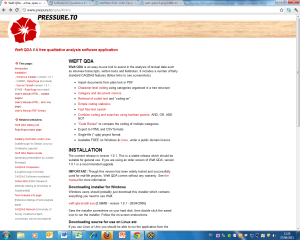
Review of Weft QDA: free open source qualitative research software

Weft QDA is an open-source free software package for qualitative research. Although I’ve doing qualitative research for a number of years this is the first time I have used software for analysing qualitative data. The expense of commercial analysis packages (£500+) has always been a deterrent for me and Weft QDA is first such package I’ve used. In this sense, I am not able to compare Weft QDA to better known commercial packages such as NVivo. In fact the Weft QDA website does outline the limitations of the package and when a commercial alternative will be necessary (e.g. when formatting is important).

I’ve been using the package to analyse the qualitative open answer data from this year’s non-specialist language learner survey. I found the programme very intuitive and easy to use. It did crash a couple of times so I quickly learnt the importance of regular saving! However, if like me you are new to using software for qualitative analysis then it is worth checking this out.

Links

Weft QDA

  • Twitter
  • del.icio.us
  • Digg
  • Facebook
  • Technorati
  • Reddit
  • Yahoo Buzz
  • StumbleUpon

A critical examination of proofreading (from latest edition of Studies in Higher Education)

I find proofreading difficult, especially proofreading my own work. I’ve long taken the view that proofreading my own work is beyond my abilities, particularly when a manuscript has gone through multiple drafts. Friends and colleagues generally concur; “You’re too close the text” they sometimes say. I’m always grateful for the professionals who perform this service on my journal articles.

Joan Turner’s critical examination of the nature of proofreading in the most recent edition of Studies in Higher Education is the first treatment of the subject I have come across (not that I have especially been looking out for an article like this, but it caught my attention when the e-mail alert from the journal came into my inbox). Student support centres which provide guidance on writing often emphasise that they are NOT a proofreading service. She writes:

 Such services offer some analysis of issues of style, grammar or rhetorical organisation that students should be aware of and attempt to resolve in their own writing, but they do not provide a 'clean' copy or 'proof' that the student can immediately submit for assessment (p. 427).

The article engages the question of proofreading from different angles. For example:

  1. Is proofreading is a skill which all students should acquire— particularly students whose first language is not English? Is it part of learning to write well?
  2. There is an ambiguity between teaching writing skills and proofreading.
  3. There is a moral question about whether getting someone to read an assessed paper is unfair. And is there an ethical difference between asking a friend to read your work and paying a professional (or non-professional) proof-reader?
  4. Will a proof-reader ‘just’ improve the writing or will they also improve the content of the text? At what point does using a proof-reader become cheating? What is being accessed—the writing or the content? Is it possible to even separate writing style from content?
  5. Does use/ overreliance on a proof-reader lead to lower standards? Does it prevent the students from learning how to write well?

Article reference

Joan Turner, “Rewriting writing in higher education: the contested spaces of proofreading,” Studies in Higher Education 36, no. 4 (2011): 427-440.

  • Twitter
  • del.icio.us
  • Digg
  • Facebook
  • Technorati
  • Reddit
  • Yahoo Buzz
  • StumbleUpon

Update from LLAS Subject Centre: post August 2011 events

I'm pleased to report that LLAS activity post-July 2011 is shaping up nicely. Our first event of the new academic year will be one for Heads of Departments which will take place in mid-September.  We also have dates for our annual e-learning symposium and our annual new staff event. Dates for e-learning and research methods courses will be up on our website soon.

Thriving in the New World of Higher Education: a workshop for heads of department and leaders in languages, linguistics and area studies

Date: 14 September, 2011

Location: Room B202, Bloomsbury Suite, School of Oriental and African Studies, University of London

Event type: Workshop

2012

e-Learning symposium 2012

Date: 26 January, 2012 - 27 January, 2012

Location: Avenue Campus, University of Southampton

Event type: Conference

Life and work in academia: event for new and aspiring lecturers in languages, linguistics and area studies

Date: 12 April, 2012

Location: Conference Aston, Aston University, Aston Triangle, Birmingham, B4 7ET

Event type: Workshop

For further details please see the LLAS website. There are more details here about the work we will be doing from 1 August.

  • Twitter
  • del.icio.us
  • Digg
  • Facebook
  • Technorati
  • Reddit
  • Yahoo Buzz
  • StumbleUpon

Area Studies: plus ça change?

Liz Lightfoot’s recent article “The value of area studies” in British Academy Review succinctly outlines the difficulties and challenges facing departments of area studies. In the eight plus years I have held the area studies remit for the Subject Centre for Languages, Linguistics and Area Studies, discussions about area studies invariably focus on the identity of the field–for example in 2004 LLAS ran a workshop entitled the Disciplinary Identity of Area Studies. In 2005, I attended a workshop entitled The Future of Interdisciplinary Area Studies run by the University of Oxford. In many respects the British Academy event The role of Area Studies in Higher Education in November 2010 was a revisiting of the Oxford conference. I even had the opportunity to reacquaint myself with many of the same people.

When I joined LLAS in 2003 my primary role was to run the Area Studies Project. A key aim of that project was build up an area studies community. There have been some successes. Driven by the project and in particular the vision of Dick Ellis, the then chair of the Area Studies Specialist Advisory Group the UK Council for Area Studies Associations (UKCASA) was formed in November 2003. It is pleasing to see that UKCASA is providing a strong voice for area studies in both teaching and research. Moreover, it has helped to bridge the gap between Anglophone and non-Anglophone area studies. The funding for the Language-based area studies centres was also an encouraging sign.

However, the questions raised when area studies is mentioned seem to be the same as they were eight years ago. And they are probably much the same as they were twenty, thirty, forty, fifty years ago. Department closures, the apparent rewarding of disciplinarily specialisation by the RAE and REF, the reliance of area studies programmes on ‘donor’ departments and questions of whether interdisciplinarity (more breath) inevitably means less depth leading to the suggestion that interdisciplinary courses might be a bit light, intellectually speaking. Naturally the latter is denied more area studies proponents who see the demands of area studies as more rather than less challenging.

Lightfoot’s article opens with the newsroom cry “Find someone who knows about Egypt!” in response the protests taking place there and elsewhere in the Middle East.  Quoted in the article Tim Wright says “The problem with providing a national resource is that no one knows where the next area of concern will come from? Will it be a need for Kurdish specialists, or people with a deep knowledge of Afghanistan, Egypt or Pakistan?”

Or Canada maybe? Well probably not, but from a government perspective a key rationale for area studies is based on the national interest, the next protest or the next war. Talk is afoot of another referendum in Quebec, but whether that referendum, whatever its outcome, will generate much interest in the UK is unclear. The rationales for area studies tend focus on the need to understand the different, the unknown, the economically important and the dangerous. Perhaps the real worry is that we will never seek to understand those societies which we see as similar, known, economically unimportant and safe.

Reference: Lightfoot, L. (2011) The Value of Area Studies, British Academy Review 17, pp. 48-51

  • Twitter
  • del.icio.us
  • Digg
  • Facebook
  • Technorati
  • Reddit
  • Yahoo Buzz
  • StumbleUpon